Phoenix Polygraph Academy
Rising to New Heights in Truth and Integrity
Basic Polygraph Examiner Course Overview
Our Basic Polygraph Examiner Course is designed to do more than just teach procedures; it prepares students to excel as well-rounded professionals. We utilize an immersive learning approach—similar to foreign language acquisition—that enables students to grasp the principles, logic, and scientific foundations underlying every phase of the polygraph process.
Our Educational Philosophy
Our curriculum is grounded in empirical research, allowing students to bridge the gap between theoretical knowledge and practical execution. This methodology is rooted in several key learning theories:
Constructivism: We move beyond rote memorization, helping students build new knowledge upon a foundation of scientific reasoning.
Experiential Learning (Kolb’s Cycle): By emphasizing "learning by doing,” students cycle through experience, reflection, and conceptualization.
Cognitive Load Theory: We structure complex technical information into manageable modules to ensure deep comprehension without overwhelming the learner.
Practical Application and Mastery
To reinforce this model, the program incorporates role-playing, hands-on exercises, and scenario-based practicums featuring mock examinations. These components simulate real-world conditions to build professional grit.
The Phoenix Advantage: Our students complete more practice examinations than those in any other known polygraph program.
This approach utilizes Social Learning Theory, where students learn through observation and imitation of expert modeling, and Situated Cognition, which ensures skills are learned in the exact contexts where they will be applied.
Individualized Instruction
We intentionally limit class sizes to provide a high level of personalized attention. This allows our instructors to:
Closely observe performance and provide immediate, meaningful feedback.
Tailor instruction to individual learning styles, utilizing differentiated instruction.
Foster an interactive environment where students are encouraged to engage in rigorous discussion.
This high level of engagement is supported by Humanistic Learning Theory, which focuses on the unique potential of each student and the importance of a supportive teacher-student relationship.
A Lifelong Professional Network
At Phoenix, we are more than a training academy - we are a family. Our commitment to your success extends far beyond graduation. We provide ongoing mentorship and support to our alumni, creating a Community of Practice where graduates have permanent access to the guidance and professional network necessary to excel throughout their careers.
Contact us directly for a multi-student discount if you are sending more than one student to the same course.
Basic Polygraph Examiner Courses
September 7 - November 13, 2026 Lakeland, FL $6000.00
January 4 - March 12, 2027 Lakeland, FL $6000.00
May 3 - July 9, 2027 Lakeland, FL $6000.00
September 6 - November 12, 2027 Lakeland, FL $6000.00
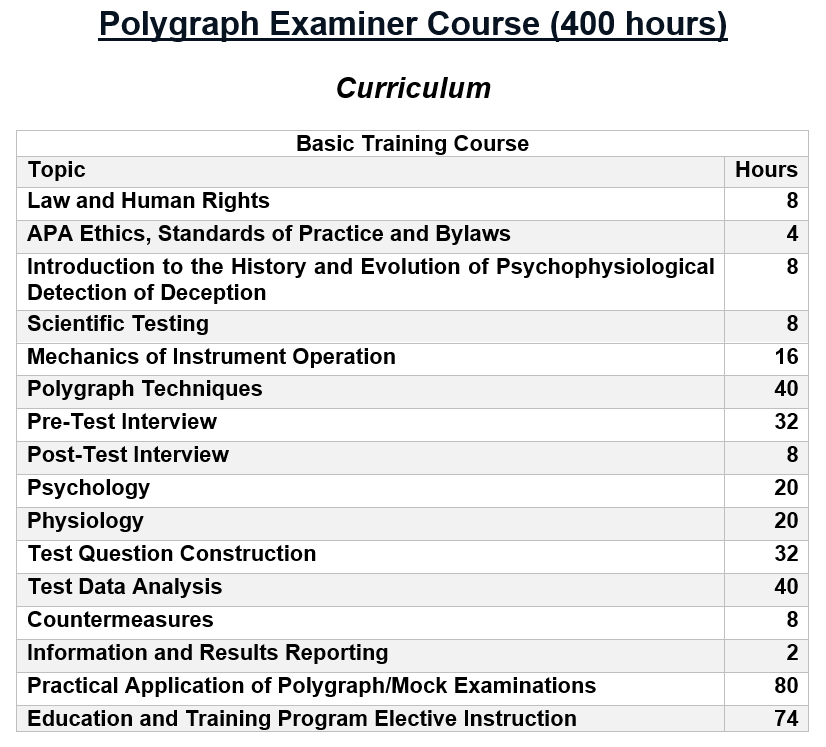
Law and Human Rights The student will learn laws, legal issues, and human rights applicable to polygraph, polygraph examiners, and examinees. The student will differentiate between proper polygraph protocols and polygraph misconduct.
APA Ethics, Standards of Practice and By-Laws The student will learn the relationships between the APA and AAPP Code of Ethics, Standards of Practice/Bylaws and other ethical considerations for the practice of polygraph.
Introduction to the History and Evolution of Psychophysiological Detection of Deception The student will be able to identify those people who made notable contributions to the early and contemporary history of polygraph and demonstrate their knowledge of the evolution of polygraph instrumentation, polygraph techniques, and test data analysis. The student will have an understanding of the development of professional associations; and alternate methods of credibility assessment.
Scientific Testing The student will demonstrate a conceptual knowledge of sensitivity, specificity, false positive errors, false negative errors and statistical significance in the application of the concepts to diagnostic and screening tests. The student will be exposed to various types of research articles regarding polygraph. The student will demonstrate the ability to differentiate between different types of research and literature, review research articles and explain their methodological strengths and weaknesses.
Mechanics of Instrument Operation The student will be able to perform a proper functionality check. The student will also be able to demonstrate the proper component placement, including primary and alternate locations in addition to the positioning of the examinee; proper software operations; acceptable data collection practices, and the use of standardized annotation on polygraph examinations.
Polygraph Techniques The student will be able to demonstrate a working knowledge of evidentiary, investigative, and screening examinations. Students will understand the essential components of these testing protocols, including the number of presentations, number of tests, and question sequence rules.
Pre-Test Interview The student will be able to explain the rationale behind pretest procedures and demonstrate the ability to conduct a free narrative, structured or semi-structured interview.
Post-Test Interview The student will be able to explain the rationale behind post-test procedures, identify basic interview approaches and demonstrate the process of post-test interviews for the various test outcomes.
Psychology The student will be able to explain the basic elements of human psychology and their applicability to the science of polygraph testing. This will include subtopics such as learning theory, perception, memory, cognition, and disorders that could impact suitability for polygraph testing.
Physiology The student will be able to demonstrate an understanding of the cardiovascular, respiratory, central nervous, peripheral nervous, integumentary and skeletal-muscular systems, as well as pharmacology, as they relate to the polygraph data.
Test Question Construction During classroom and laboratory exercises the student will demonstrate, in writing, an effective working knowledge of polygraph test questions for validated polygraph techniques.
Test Data Analysis The student will demonstrate a working knowledge of the physiological response patterns used in interpretation of polygraph data, in addition to an ability to identify data suitable and not suitable for analysis. Students will learn to analyze polygraph data using a validated scoring system, including the appropriate use of decision rules.
Countermeasures The student will be able to describe common types of countermeasure attempts and atypical physiology.
Information and Results Reporting The student will demonstrate an understanding of the fundamentals of ethical and effective reporting practices. The student shall demonstrate a conceptual understanding of reporting test data analysis results that is consistent with the American Polygraph Association’s Standards of Practice.
Practical Application of Polygraph/Mock Examinations The student will demonstrate basic proficiency in conducting examinations under field-like conditions.
Education and Training Program Elective Instruction The student will be familiarized with other polygraph-related content or given additional instruction on topics at the discretion of the training center.